
Grinder Pumps 101: What Lago Vista Homeowners Need to Know
If you live in Lago Vista, chances are pretty good there’s a grinder pump tucked away on your property doing some quiet, unglamorous work – and most folks never think about it until it stops working. So we sat down with Chris, our Service Manager here at Reliant Plumbing, and asked him to walk us through it in plain English: what these systems actually do, what tends to go wrong, and what it costs to get one fixed.
What Is a Grinder Pump, Anyway?

Put simply, a grinder pump earns its keep on properties where gravity alone can’t get wastewater to the sewer. That’s not just a hilly-lot problem, either – long pipe runs, elevation changes, and pressurized sewer systems all call for one too. (If you want the more technical rundown, Trenchlesspedia has a good breakdown of how these systems are engineered.)
“They’re commonly used when the terrain of the property is hilly or on a steep incline where gravity can’t do the trick,” Chris told us.
So How Does It Actually Work?
Here’s the good news: from your end, nothing changes. “It’s really a simple process,” Chris says. “It’s similar to flushing a toilet or running a faucet on a standard gravity-led sewage system.”
Behind the scenes, though, things work a little differently. “The water goes down and into a basin rather than going straight to the city sewer,” Chris explains. “The basin fills to a certain point, and then [a sensor] kicks on and triggers the pump.” Some systems use a float switch for that, others use a different kind of level sensor, but either way, the pump grinds everything up and pushes it out through a discharge line to the municipal sewer.
Grinder Pump vs. Sump Pump – They’re Not the Same Thing
We hear these two mixed up all the time, so let’s clear it up. “A sump pump isn’t really designed to take on solids in a sewage system,” Chris says. “A grinder pump will take on feces or other solids that flow through a sewage system, grind them up, and then eject the waste through the sewer line.” A regular sump pump has no business handling sewage, period – ask one to do a grinder pump’s job and you’re asking for trouble.
What About a Septic System – Is That the Same as a Grinder Pump?
Not quite, even though they’re often lumped together. A grinder pump’s whole job is to move wastewater from your home to the municipal sewer – that’s it. A septic system is a different animal altogether, treating and disposing of wastewater right there on your property through a multi-step process. As Chris puts it, “a grinder pump system is a one-step process. Water flows in, hits the pump, gets ground up, and is ejected out.”
Signs Your Grinder Pump Might Be in Trouble
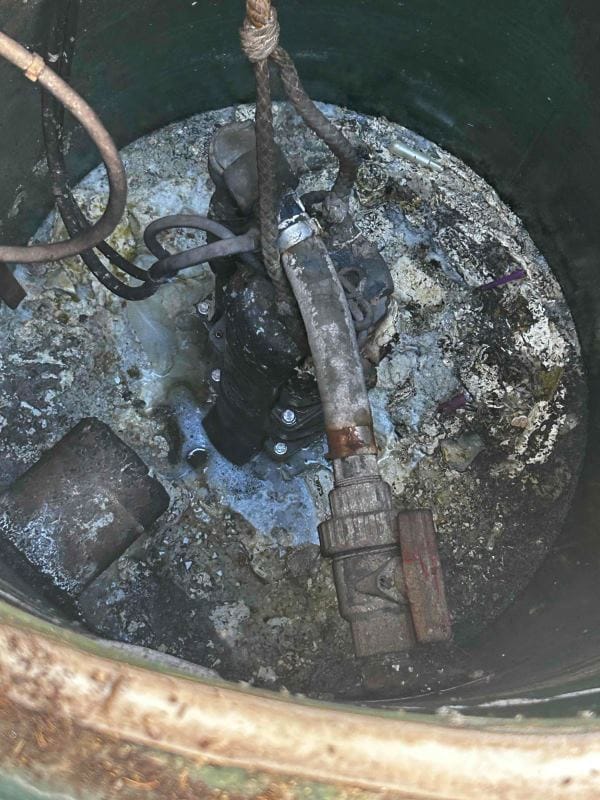
Most systems will warn you with an alarm – usually a light, sometimes a sound too. “The first thing you should do if you hear the alarm or see the red light is call a plumbing company,” Chris says. Before you make that call, here’s what we’d tell a neighbor to do:
- Ease up on water use right away. Hold off on laundry, dishes, long showers – anything that adds more water to the system while it’s struggling.
- Give a plumbing company a call. Don’t wait around hoping it sorts itself out.
What Usually Causes a Grinder Pump to Fail?
“Nowadays, I would say the most common cause of failure for grinder pump systems is the use of wipes,” Chris told us, speaking from what he’s seen out in the field. “Flushable” or not, wipes just don’t break down like toilet paper does, and they love to jam up a grinder. That said, they’re far from the only cause – worn parts, an aging system, and buildup from other things that shouldn’t go down the drain can all lead to failure too. If you’re not sure what’s going on, a camera inspection can usually spot the culprit without any guesswork.
Not Sure If It’s an Emergency?
Honestly, when in doubt, treat it like one. “If you’re not sure, it’s better to be safe than sorry,” Chris says. “Call a plumbing company out, have them inspect the system, and go from there.”
Why Do So Many Lago Vista Homes Have Grinder Pumps in the First Place?
A lot of it comes down to the terrain around here – Lago Vista has enough hills and elevation change that gravity-fed sewer lines just aren’t practical for a lot of properties. Some homes also sit a fair distance from the nearest municipal sewer tap, which can call for a high-head grinder pump built to push wastewater farther than a standard one can manage. If you want specifics on your own property’s tap distance or pump setup, your city utility or a plumber who knows your neighborhood is the best place to get a straight answer.
Septic or City Sewer? Here’s How to Know Which One You’ve Got
Some pockets of Lago Vista are still on septic, while others have switched over to municipal sewer service. “A really easy way to tell is to do a quick perimeter check around the house and see if you notice any lids or control boxes,” Chris suggests. That can give you a hint, but it’s not a sure thing on its own – the most reliable way to know for certain is to just call your city utility, and “they should be able to tell you,” Chris adds.
What’s a Grinder Pump Repair or Replacement Going to Cost?
There’s no one-size-fits-all number here, unfortunately. “The cost of repairing or replacing a grinder pump system can vary quite a bit,” Chris explains. Cost comes down to a handful of factors, including:
- Pump type and required head (how far or how high the pump has to push the wastewater)
- Discharge distance and elevation changes
- How accessible the basin and pump are
- Condition of the basin and controls
- What actually failed on the system
- Size of the home and number of fixtures
Because there are so many moving pieces, “the best way to determine the cost is to have someone come out, take a look at the system, and provide options,” Chris says. If you’re on a maintenance membership, a routine checkup can also catch small issues before they turn into a full pump replacement.
Think Your Grinder Pump Needs a Look?
If that alarm is going off, something seems off, or you’re just not sure what kind of system your home even has – give us a call. We’ll come take a look and tell you straight what’s going on, no guesswork involved.